Released: AI Agent Package template — build and grow AI agents that understand your business
Generative AI is shifting from "tool you direct" to "partner you work with." The AI Agent Package combines autonomous agents and workflow-style agents so you can hand off operations to AI step by step.
The next phase of "field-ready" generative AI: enterprises hand operations to AI agents themselves
As generative AI rapidly spreads across the workplace, the limits of treating it merely as a "tool to use well" are becoming apparent — it cannot solve operational problems at the root.
What comes next is a shift in mindset: handing the actual operations themselves over to AI agents.
In other words, the next chapter of generative AI is not about "directing" AI; it is about "working alongside" AI as a partner.
We believe that "growing" autonomous AI agents — and gradually entrusting parts of the operation to them — is the way to lift field productivity reliably and sustainably.
For example, in sales management with Salesforce…
Sales teams are expected to use the daily-accumulating Salesforce data to spot gaps against the budget and quickly weigh next moves. In reality, much time goes into shaping the data and aligning assumptions before any decision can be made.
Sales-data analysis depends on context — which numbers matter, what is driving them.
By teaching that knowledge and decision logic to an AI agent, you grow it into one capable of analysis and proposals tuned to the field.
In our demo, an AI agent analyzes sales data accumulated in Salesforce, calculates the gap to the budget, and organizes the information needed for next-action planning. The opening shows the agent being "taught" data definitions and "remembering" them — it carries forward human know-how.
A way to "incrementally hand operations over to AI"
Our AI agents combine two different types — autonomous and workflow-driven — so the move toward AI happens incrementally and flexibly, fit to your operations.
A "growing autonomous agent" model: teach the agent operational context and judgment criteria bit by bit, and let the AI itself grow.
A "moving operations into a workflow-driven agent" model: identify which parts of your existing flow can be automated and shift them in order.
Combining the two lets you start small, fit to the field, and naturally step up to entrusting AI with higher-level judgment and execution.
Growing the autonomous agent
An autonomous AI agent designs and executes tasks on its own. It understands the flow and goals of the operation, decides what processing is needed, and coordinates with other tools and agents to drive tasks to completion.
By teaching the autonomous agent the background of your operations, the procedures, and the meanings of in-house terminology, it grows into a practical AI agent fluent in your business and your field-language.
Eventually, drawing on accumulated knowledge and operational context, the agent can analyze data autonomously and surface findings or next-best-action suggestions to its users.
In exaBase Studio, the user interfaces for managing autonomous agents and receiving execution reports are currently in development.
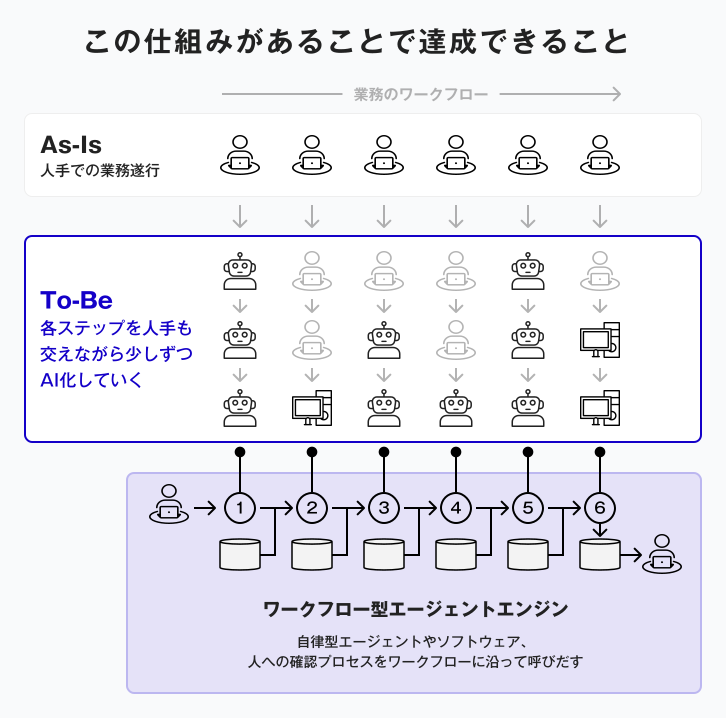
Moving operations into the workflow-driven agent
To make AI adoption stick on the ground, do not delegate everything at once. Make today's operations visible and shift parts of them to AI agents — starting with what is feasible.
The workflow-driven agent in exaBase Studio lets you define real business processes as flow diagrams while flexibly splitting human and AI roles at each step.
Within the flow, you can shift simple tasks to the AI agent first, enabling a smooth transition without disruption.
You can also call the autonomous agent from inside the workflow. For steps that demand more complex judgment — sales report generation, improvement proposals — the autonomous agent picks up the situation, decides, and executes.
This way, with the workflow-driven agent as your entry point and the autonomous agent collaborating from inside, you can hand AI a wide range of work — from routine tasks to those requiring thinking.